

Beschrijving
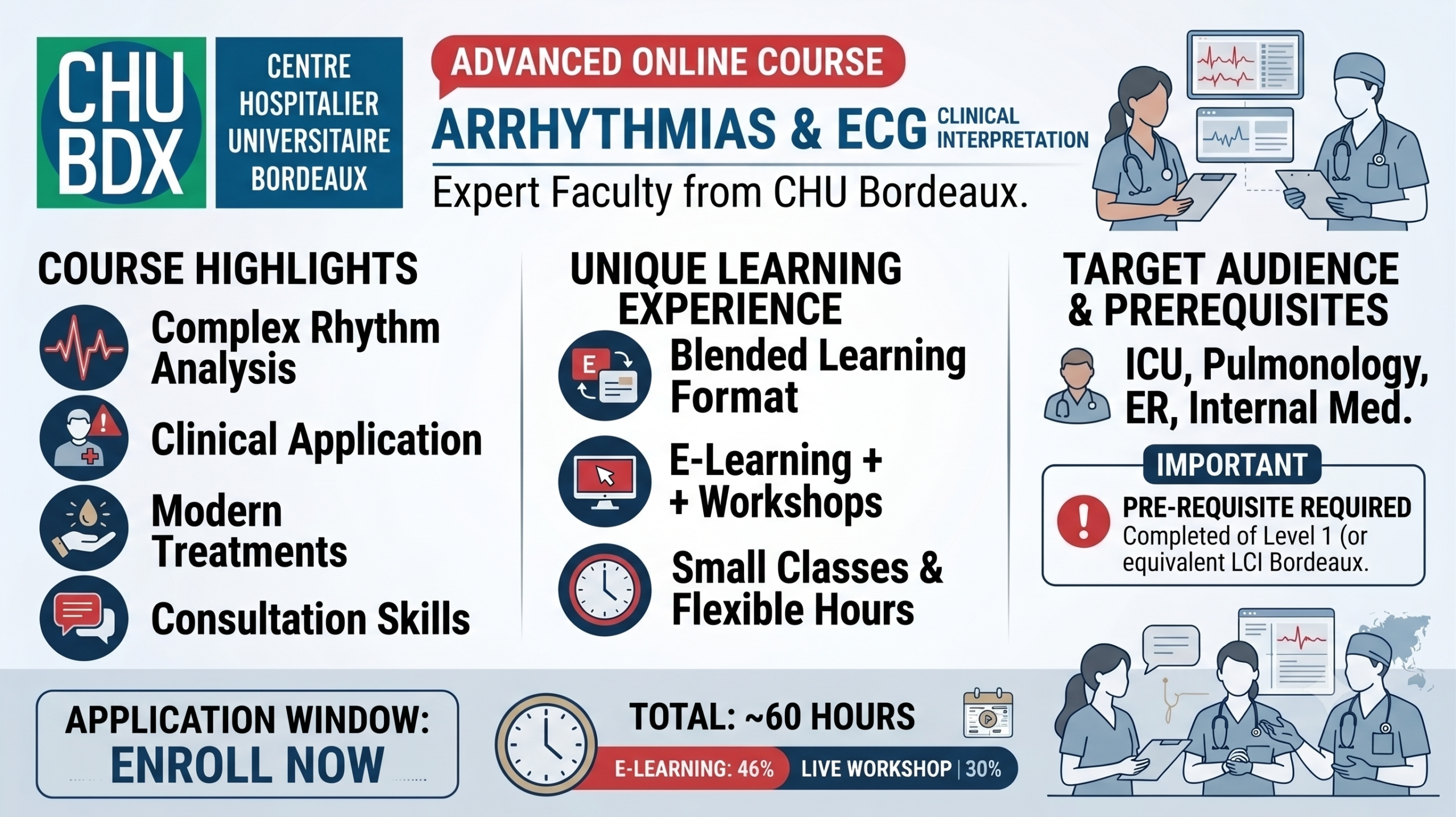
Building on our ECG and arrhythmia programmes for critical care, we now introduce a dedicated module on the acute cardiac patient in the ICU.
CARDIAC EMERGENCIES IN THE INTENSIVE CARE UNIT
Online Course for Intensivists & Critical Care Physicians
Do you manage cardiac arrest, shock, malignant arrhythmias or a failing pacemaker at 3 a.m. — and want a structured, cardiology-backed approach?
This English-language course is designed for intensivists, ICU residents and fellows, anaesthesiologists and emergency physicians who treat cardiac emergencies in the intensive care unit. It combines rapid bedside recognition (ECG, monitoring, echocardiography) with practical, guideline-based treatment and clear criteria for when and how to involve the cardiology team.
COURSE OBJECTIVES
- Apply a systematic bedside approach to the unstable cardiac patient (ECG, monitoring, haemodynamics, focused echo)
- Recognise and treat life-threatening arrhythmias: VT/VF, electrical storm, unstable AF, bradycardia and high-grade AV block
- Optimise cardiac arrest and post-ROSC care in the ICU
- Diagnose and manage cardiogenic shock, including inotropes, vasopressors and mechanical circulatory support
- Identify acute coronary syndromes and ischaemia in sedated and ventilated patients
- Handle obstructive emergencies: tamponade, massive pulmonary embolism, aortic dissection
- Manage pacemakers, ICDs and temporary pacing in the ICU
- Prevent and treat drug-induced and electrolyte-related arrhythmias (QT prolongation, torsades, hyperkalaemia)
PROGRAMME
Module 1 — The unstable cardiac patient: a structured bedside approach
- Rapid assessment: rhythm, perfusion, congestion
- 12-lead ECG and continuous monitoring in the ICU: what to look for, pitfalls and artefacts
- Focused cardiac ultrasound for the intensivist (LV/RV function, pericardial effusion, volume status)
Module 2 — Cardiac arrest and post-resuscitation care
- In-ICU cardiac arrest: shockable vs non-shockable rhythms, reversible causes
- Post-ROSC ECG: who needs urgent coronary angiography?
- Temperature control, haemodynamic targets and neuroprognostication basics
Module 3 — Tachyarrhythmias
- Broad complex tachycardia: VT vs SVT with aberrancy
- Electrical storm: sedation, antiarrhythmics, beta-blockade, when to call the EP team
- New-onset AF and flutter in sepsis and after surgery: rate vs rhythm control, anticoagulation
- Synchronised cardioversion in the ICU
Module 4 — Bradyarrhythmias and pacing
- AV block, sinus node dysfunction, drug and electrolyte causes
- Atropine, isoprenaline, transcutaneous and transvenous temporary pacing
- Troubleshooting a temporary pacing wire (loss of capture, undersensing, oversensing)
Module 5 — Acute coronary syndromes and myocardial injury in the ICU
- STEMI and STEMI equivalents, troponin elevation in critical illness, type 2 MI
- Mechanical complications: papillary muscle rupture, VSD, free-wall rupture
- Takotsubo and myocarditis
Module 6 — Cardiogenic shock and acute heart failure
- SCAI shock stages and haemodynamic phenotypes
- Inotropes and vasopressors: choice, dosing, pitfalls
- Mechanical circulatory support (IABP, Impella, VA-ECMO): indications and ICU management
- Acute pulmonary oedema and ventilation in the failing heart
Module 7 — Obstructive and vascular emergencies
- Cardiac tamponade: recognition and pericardiocentesis
- High-risk pulmonary embolism: thrombolysis, catheter-directed therapy, ECMO
- Acute aortic dissection: blood pressure and heart rate control
Module 8 — Devices, drugs and electrolytes
- Pacemakers and ICDs in the ICU: magnet use, inappropriate shocks, end-of-life deactivation
- QT prolongation and torsades de pointes: high-risk ICU drugs
- Hyperkalaemia, hypokalaemia, hypomagnesaemia and toxic arrhythmias
Final assessment
- Case-based quiz with ECGs, monitoring strips and echo clips from real ICU patients
- Certificate of completion
LEARNING FORMAT
- Structured e-learning modules:
- Step-by-step treatment algorithms
- Annotated ECGs, monitoring strips and echo clips
- Real ICU case scenarios
- Interactive online expert sessions with cardiologists, electrophysiologists and intensivists from:
- Bordeaux, France
- The Netherlands
Small groups (max 5 participants) ensure:
- High interactivity
- Discussion of your own ICU cases
- Personalised feedback
- Flexible scheduling (evenings/weekends)
TIME COMMITMENT
- Total: ~40–50 hours
- Self-paced e-learning
- Live expert sessions
TARGET AUDIENCE
- Intensivists and critical care consultants
- ICU residents and fellows
- Anaesthesiologists and emergency physicians caring for critically ill cardiac patients
RECOMMENDED PREREQUISITE
Basic ECG knowledge (Part 1 of our critical care ECG course, or equivalent)
GOAL
Give intensivists the confidence and structure to recognise, stabilise and treat cardiac emergencies in the ICU, and to work hand in hand with the cardiology team when every minute counts.
From the monitor alarm to the right treatment — learn cardiac emergency care in the ICU with international experts.
Beoordelingen
Er zijn nog geen beoordelingen.